Like creatures of the night, the deer slink into my yard silently, ravaging everything in sight. It seems that nothing is safe and there's no place to hide! AAAAAAAHHHHHH!!!!
But, really, it is possible to have a garden that the deer only nibble on, subtly tasting here and there, deadheading a few flowers, pruning a few shrubs.
Once we accept the idea that we can't eradicate every deer (rabbit, vole, beaver) (yes, I have beavers in my area who have removed quite a few backyard trees), we learn to live side-by-side with them. In a sense.
I don't plant aspens but the ones that come up are allowed to grow, knowing that the beavers will remove them in about 5 years (they're aspen connoisseurs since they wait until the little trees are really tasty, I think). During cold winters, voles tunnel into my greenhouse - to stay warm, I suppose. I make sure there are no plants at ground level for them to eat (learned that lesson the hard way).
The deer and I have reached a compromise - I watch from the window and re-direct them when they go for the Delphiniums (they don't like window tapping) and just supervise when they trim the Baby's Breath and the Scabiosa. The apple trees are fenced until they're tall enough to grow apples above a deer's head.
Otherwise, I grow a lot of deer resistant plants - no such thing as deer-proof and don't let anyone tell you there are. OSU Extension Service has some great publications with the best plants to grow here (http://extension.oregonstate.edu/deschutes/wildlife-damage). I've got Thyme ground cover, Lavender, Shasta Daisies, Bachelor Buttons, Basket of Gold, Sweet William, Lady's Mantle, Russian Sage, Blue Oat Grass, Butterfly Bushes, Spruces, and Atlas Cedar. I know that the native plants will do well for drought and deer resistance so I've tried to incorporate some of them in the yard - Lupine, Penstemon, Bleeding Heart, Spirea. (Serviceberry is a great native tree but the beavers took 3 of mine one year). Plants that I absolutely must have (!!) get a sprinkling of one of the many deer avoidance products - last year I had great luck with Critter Ridder, although it's pricey.
I've also learned that the list has some plants (like the Delphiniums) that my local deer love to eat to the ground. They even eat the leaves, but not the flowers, of the little blue Grape Hyacinths every Spring. Very strange.
Looking at the OSU Extension list, a gardener can feel pretty optimistic that they can have a gorgeous garden in spite of the co-existing wildlife.
COMGA

Tuesday, April 21, 2015
Saturday, April 11, 2015
Design a Garden Room
Did you design your own garden? Are you like a neighbor of mine who sees plants at the store and brings them home, not knowing where they'll be planted or how they'll look in her yard? Or have you given up and your home is surrounded by green lawn, from the sidewalk to the foundation?
Designing a garden is pretty intimidating - my first garden "design" was a disaster with large plants that grew over smaller ones, plants that loved water growing next to plants that liked dry conditions (neither plant was happy) and orange flowers blooming up against purple ones. It made such an ugly yard that I never wanted to be in it, no less maintain the plants.
Then I read a brilliant article about Garden Rooms. It's an old concept that people are re-discovering: think about how you want to use your yard or garden and design for it. We do it all the time inside our homes, this is just an extension of that idea.
I have a shady area that just begged for an arbor where I could sit on a warm summer afternoon, leaning on a pillow and drinking a mint julep (I don't know what a mint julep is, but it sure sounds refreshing, doesn't it?). A big box store had an End-of-Summer sale a few years ago and I picked up a pretty metal arbor with built-in benches for a great price. The next Spring I planted a Silver Lace Vine at the back and it's given me oodles of shade and tiny white flowers every Summer since. It needs a bit of pruning back every year but at the end of a busy August day I really appreciate the sitting room I've created.
My home sits north to south, so my large side yard faces east - my 'room' there is almost a secret garden with a simple wooden bench facing the small lawn and surrounded by blooming shrubs (Forsythia and Daffodils in Spring, Butterfly Bushes and Clematis in Summer, annuals all season long). Since the sun moves slowly across the space, it has a gentle, quiet light that is very peaceful and I often sit there between garden tasks tossing a ball for the dog. This area is a playroom - a great place to sit and work on my garden journal or watch the grandkids play a vigorous game of croquet.
The south side of my home is the work room: it has a greenhouse, a cold frame and vegetable beds. It's filled with bright light 12+ hours of the day and feels very active with birds, butterflies and bees constantly flying past. It's like a kitchen with regular activity producing wonderful results.
The front yard is, as most people expect, the entry hall - semi-formal plantings of spruce trees lining the driveway, grasses along the walk, flowers at the front door. It's designed so that the plants will look good in every season (or at least have interesting textures even in the Winter), colors are complementary (the same shades and/or opposite colors on a color wheel) and are low maintenance so they're always ready for visitors.
Of course, I also have that ubiquitous storage room, the place where the compost pile 'lives', the woodpile is stored, the trash barrel sits. It's hidden behind the garage and surrounded by a huge False Spirea (Sorbaria sorbifolia) which hides the ugliness quite well. Not always pretty but very important to everyday life.
What will your garden rooms look like? Do you have a dog who needs a sawdust pile to roll in? Some pre-teens who need room to play soccer (and a seating area to rest)? Or maybe you'd like a dining patio surrounded with plants that make you feel like you're at a Pacific Island resort? The possibilities are endless if you let your imagination roam. Take your time, do some sketches, look through a few library books and you may be surprised with how much fun it can be to design your own Garden Room.
Here's a fun publication to get you started: http://tinyurl.com/oj2l29y
Designing a garden is pretty intimidating - my first garden "design" was a disaster with large plants that grew over smaller ones, plants that loved water growing next to plants that liked dry conditions (neither plant was happy) and orange flowers blooming up against purple ones. It made such an ugly yard that I never wanted to be in it, no less maintain the plants.
Then I read a brilliant article about Garden Rooms. It's an old concept that people are re-discovering: think about how you want to use your yard or garden and design for it. We do it all the time inside our homes, this is just an extension of that idea.
I have a shady area that just begged for an arbor where I could sit on a warm summer afternoon, leaning on a pillow and drinking a mint julep (I don't know what a mint julep is, but it sure sounds refreshing, doesn't it?). A big box store had an End-of-Summer sale a few years ago and I picked up a pretty metal arbor with built-in benches for a great price. The next Spring I planted a Silver Lace Vine at the back and it's given me oodles of shade and tiny white flowers every Summer since. It needs a bit of pruning back every year but at the end of a busy August day I really appreciate the sitting room I've created.
My home sits north to south, so my large side yard faces east - my 'room' there is almost a secret garden with a simple wooden bench facing the small lawn and surrounded by blooming shrubs (Forsythia and Daffodils in Spring, Butterfly Bushes and Clematis in Summer, annuals all season long). Since the sun moves slowly across the space, it has a gentle, quiet light that is very peaceful and I often sit there between garden tasks tossing a ball for the dog. This area is a playroom - a great place to sit and work on my garden journal or watch the grandkids play a vigorous game of croquet.
The south side of my home is the work room: it has a greenhouse, a cold frame and vegetable beds. It's filled with bright light 12+ hours of the day and feels very active with birds, butterflies and bees constantly flying past. It's like a kitchen with regular activity producing wonderful results.
The front yard is, as most people expect, the entry hall - semi-formal plantings of spruce trees lining the driveway, grasses along the walk, flowers at the front door. It's designed so that the plants will look good in every season (or at least have interesting textures even in the Winter), colors are complementary (the same shades and/or opposite colors on a color wheel) and are low maintenance so they're always ready for visitors.
Of course, I also have that ubiquitous storage room, the place where the compost pile 'lives', the woodpile is stored, the trash barrel sits. It's hidden behind the garage and surrounded by a huge False Spirea (Sorbaria sorbifolia) which hides the ugliness quite well. Not always pretty but very important to everyday life.
What will your garden rooms look like? Do you have a dog who needs a sawdust pile to roll in? Some pre-teens who need room to play soccer (and a seating area to rest)? Or maybe you'd like a dining patio surrounded with plants that make you feel like you're at a Pacific Island resort? The possibilities are endless if you let your imagination roam. Take your time, do some sketches, look through a few library books and you may be surprised with how much fun it can be to design your own Garden Room.
Here's a fun publication to get you started: http://tinyurl.com/oj2l29y
Thursday, April 9, 2015
Weeds Weeds WEEDS!
You've heard of a Field of Dreams - the Master Gardeners recently tackled a Field of Weeds at the OSU Extension Office Demonstration Garden. We're pretty lucky to know what exactly the plant is that we're digging out but it doesn't make the job any easier, despite working side by side with some great friends!
Of course, knowing who we are, we first had to identify the weed that was a "wall-to-wall carpet".
 What a pretty little flower!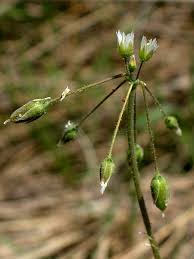
But that sweet little thing (it's Jagged Chickweed) will be shooting seeds near and far in a week or two - overwhelming every other plant we might be putting in the garden. So! Begone with you, pest!
Seriously, we always identify the weed we're pulling since
So this is what we need to ask:
When that day spent weeding at the OSU Extension Service office was over, we all stood and looked back at our former Field of Weeds and knew that even Shoeless Joe would have been proud of our work in the future Field of Greens (and Pinks, Yellows, Reds and occasional Blues).
These are a couple good resources from our own Oregon State University publications:
http://mint.ippc.orst.edu/weedidentification.htm
http://forages.oregonstate.edu/nfgc/eo/onlineforagecurriculum/instructormaterials/availabletopics/weeds/lifecycle
If you have any questions about weeds in Central Oregon, call the Master Gardener Plant Clinic at any of the OSU Extension Offices in Crook, Deschutes or Jefferson Counties. They'll be happy to help answer any gardening questions you may have.
Of course, knowing who we are, we first had to identify the weed that was a "wall-to-wall carpet".
But that sweet little thing (it's Jagged Chickweed) will be shooting seeds near and far in a week or two - overwhelming every other plant we might be putting in the garden. So! Begone with you, pest!
Seriously, we always identify the weed we're pulling since
- it might not be a weed - it could be a plant from last year that has re-seeded and we may want to let the new plant stay (I've got cornflowers, sunflowers, larkspur and hollyhocks growing in my yard that I haven't intentionally planted in 4 or 5 years!).
- it could be an annual weed that has already dropped its seeds (it's a Winter weed) and we'll need to be more alert to seedlings coming up in the bed after we've planted it.
- it could be a perennial weed and it's become invasive. Some of these miserable excuses for plants have "vegetative structures" that grow deep underground, resurfacing to torment us year after year. (do you think I may be taking this a little personally?).
- it could be a biennial weed - last year it may have been just a pest but this year it'll be producing seeds to keep itself going in my garden for many years to come (okay, that time it was personal!).
So this is what we need to ask:
- is this little plant a weed?
- is this a weed that will flower in this season?
- if I use an herbicide, what will be the least toxic and most effective one for this kind of weed? And when should I use it?
- has this weed already finished flowering and won't be affected by any herbicide?
- can I just pull this weed - root, stem, flower and all - and eliminate the need for herbicides?
When that day spent weeding at the OSU Extension Service office was over, we all stood and looked back at our former Field of Weeds and knew that even Shoeless Joe would have been proud of our work in the future Field of Greens (and Pinks, Yellows, Reds and occasional Blues).
These are a couple good resources from our own Oregon State University publications:
http://mint.ippc.orst.edu/weedidentification.htm
http://forages.oregonstate.edu/nfgc/eo/onlineforagecurriculum/instructormaterials/availabletopics/weeds/lifecycle
If you have any questions about weeds in Central Oregon, call the Master Gardener Plant Clinic at any of the OSU Extension Offices in Crook, Deschutes or Jefferson Counties. They'll be happy to help answer any gardening questions you may have.
Tuesday, April 7, 2015
Where did the Spring Go????
Are you as cold as I am? Where did those 60+ degree days go?
When the Master Gardeners sold spring-flowering bulbs a few years ago, we were sometimes asked what would happen if it snowed on the bulbs. Luckily, not much, I've found.
 |
| These crocus are ready to pop open, despite the snow |
If you're growing bulbs in your yard, now's a good time to mark where they are. I've used a couple methods: maps, digital photos, plastic stakes near the stems (not too close so the bulb isn't injured). Years past, in late Summer, I pushed my trowel in the flower bed and came up with HALF a bulb , not realizing I was in the Daffodil bed! It was very painful, knowing that the bulb is trash because I was too lazy to mark the spot.
So, learn from my sad example & somehow mark your bulbs - you'll be grateful next summer.
By the time June finally arrives, you'll look out at that same Daffodil bed and have just floppy green stems & leaves with shriveled, dried flowers on them (unless you cut them to bring inside back in April). Can't you cut back those ugly leaves?
In a word, no. Sorry. That was not the answer you were hoping for, right?
You have probably heard that the leaves are building up the energy for the bulb to produce a gorgeous flower next Spring. To help the bulb you can sprinkle some balanced fertilizer (all 3 numbers are the same) around the leaves; it'll help build strong roots and boost the nitrogen in the stems and leaves. Even tying or bundling the leaves is not a good idea but you can easily hide them.
Here's how to mask the old leaves:
- Plant annuals around the bulbs and allow the bulb leaves to flop between the plants.
- Carefully surround the bulbs with plants whose growth will happen after the bulbs bloom.
- We've found that hostas begin to leaf out just as the Daffodils fade. As the hostas grow tall, the Daffodils flop between the plants.
- We've done the same thing with Alliums planted amongst Asters.
- Bleeding Heart, True Geraniums, Ornamental Grasses will all hide the stems.
- Plant taller annuals or perennials in front of the bulbs - when they bloom, you'll be distracted and won't care about the ugly flopping bulb leaves in the back.
I like this photo of Daffodils hidden among Centaurea montana (perennial Cornflower). Color for every season!

I'd love to hear what's worked for you - let me know in the comments.
Check out these sites for ideas: http://ucanr.edu/datastoreFiles/268-547.pdf and http://tinyurl.com/nj5nt65
Sunday, April 5, 2015
Starting Seeds for the Garden
Isn't it amazing how excited you can become when the seeds you so cautiously dropped exactly (??) 1/4" into the potting soil, oh so delicately watered, and positioned oooh sooo carefully under the grow light (not too close, not too far away) finally come up?
I didn't realize how quickly lettuce sprouts - in just 3 days, I have arugula seedlings. Teeny tiny seedlings, but they're there nonetheless. By the 4th day, the rest of the lettuce varieties came up - butterhead (how yummy does that sound?), Tom Thumb, oak leaf, Bullet (that's a romaine and you can see how it got named) and one called Victoria Springs. By mid-summer, when it starts to get really warm, I'll have gotten several months of salad greens from just two dozen seedlings - picking the outer leaves and leaving the main 'stem' to keep growing. Of course, the head lettuces are a one-shot harvest, but they're so good, I can't resist growing them.
Have you ever started seeds? Every Spring and Summer I'm impressed by how fearless nature is - some of the seeds I plant are no bigger than a dust mote (I'm talking to you, Lobelia!) but they send down their little roots and push up through the potting soil to make beautiful plants to brighten my yard and fill my kitchen. Every year, the same process consistently occurs - if I do my part well.
If you want to join the growing crowd of seed starters, you'll need a bag of seedling mix, some kind of 'pot' to put the mix into, and seeds of plants that will grow in your area. If you have any kind of scooper and some plastic, you're set.
Seedling mix is lighter than potting soil so it helps the seeds push through to the light - you'll be much more successful if you pick some up at any gardening store. If you have small containers (the store-bought black plastic kind are not the only choice), be sure they have a hole for drainage and aren't too big - the seeds seem to do better when their roots don't have as far to reach.
Fill your containers with the seedling mix, tamp it down and follow the seed packet's directions for depth. Once the seed is planted, tamp it down again so it's in contact with the soil. Water the surface when needed (the top can dry out between watering but over-watering will suffocate the seeds & they'll rot in the ground) and, once the seedlings come up, water only from the bottom.
Put the containers near a bright window and cover with a plastic bag, plastic wrap or a sheet of plastic or glass. Water will condense and drip back onto the soil and that's okay as long as the soil isn't standing in water 24/7. You're aiming for damp, not drenched.
If you have a grow light (or a shop light), the seedlings will be especially happy. If you can, buy one bulb that glows pink (an "aquarium light") and one that glows blue (a regular fluorescent) - they will cover the range of light waves that plants need.
I always make a little chart of the seeds planted: the type, the planting date, the expected germination date range, and the date they sprout. Before I did the chart, I sometimes gave up on the seeds too soon, not knowing that they would take longer to sprout. But sure to put some kind of a label in or on the pots unless you're only growing one type. My family loves to tell the story of the year the labels were mixed up on the pepper plants - hot peppers and sweet peppers all growing together and we didn't know what we would be getting. It was like taking all the labels off the canned goods in the pantry! I never want to repeat that experience.
In June I'll be planting my seedlings outside and late in the Summer I'll be saving seeds from my garden. I'll be posting photos so you can see if my Summer garden grows as well as my Spring plans!
Here's a great PNW publication to download: https://catalog.extension.oregonstate.edu/pnw170 (when the page opens, click on "View it now" for the free download)
I didn't realize how quickly lettuce sprouts - in just 3 days, I have arugula seedlings. Teeny tiny seedlings, but they're there nonetheless. By the 4th day, the rest of the lettuce varieties came up - butterhead (how yummy does that sound?), Tom Thumb, oak leaf, Bullet (that's a romaine and you can see how it got named) and one called Victoria Springs. By mid-summer, when it starts to get really warm, I'll have gotten several months of salad greens from just two dozen seedlings - picking the outer leaves and leaving the main 'stem' to keep growing. Of course, the head lettuces are a one-shot harvest, but they're so good, I can't resist growing them.
Have you ever started seeds? Every Spring and Summer I'm impressed by how fearless nature is - some of the seeds I plant are no bigger than a dust mote (I'm talking to you, Lobelia!) but they send down their little roots and push up through the potting soil to make beautiful plants to brighten my yard and fill my kitchen. Every year, the same process consistently occurs - if I do my part well.
If you want to join the growing crowd of seed starters, you'll need a bag of seedling mix, some kind of 'pot' to put the mix into, and seeds of plants that will grow in your area. If you have any kind of scooper and some plastic, you're set.
Seedling mix is lighter than potting soil so it helps the seeds push through to the light - you'll be much more successful if you pick some up at any gardening store. If you have small containers (the store-bought black plastic kind are not the only choice), be sure they have a hole for drainage and aren't too big - the seeds seem to do better when their roots don't have as far to reach.
Fill your containers with the seedling mix, tamp it down and follow the seed packet's directions for depth. Once the seed is planted, tamp it down again so it's in contact with the soil. Water the surface when needed (the top can dry out between watering but over-watering will suffocate the seeds & they'll rot in the ground) and, once the seedlings come up, water only from the bottom.
Put the containers near a bright window and cover with a plastic bag, plastic wrap or a sheet of plastic or glass. Water will condense and drip back onto the soil and that's okay as long as the soil isn't standing in water 24/7. You're aiming for damp, not drenched.
If you have a grow light (or a shop light), the seedlings will be especially happy. If you can, buy one bulb that glows pink (an "aquarium light") and one that glows blue (a regular fluorescent) - they will cover the range of light waves that plants need.
I always make a little chart of the seeds planted: the type, the planting date, the expected germination date range, and the date they sprout. Before I did the chart, I sometimes gave up on the seeds too soon, not knowing that they would take longer to sprout. But sure to put some kind of a label in or on the pots unless you're only growing one type. My family loves to tell the story of the year the labels were mixed up on the pepper plants - hot peppers and sweet peppers all growing together and we didn't know what we would be getting. It was like taking all the labels off the canned goods in the pantry! I never want to repeat that experience.
In June I'll be planting my seedlings outside and late in the Summer I'll be saving seeds from my garden. I'll be posting photos so you can see if my Summer garden grows as well as my Spring plans!
Here's a great PNW publication to download: https://catalog.extension.oregonstate.edu/pnw170 (when the page opens, click on "View it now" for the free download)
Friday, April 3, 2015
Growing an Apple Tree in Central Oregon
How geeky is this: I'm really excited about a new program that OSU Extension Service in Redmond will have this Spring. It's called "Project Happy Apple" - once I sign up on their website (extension.oregonstate.edu/deschutes/project-happy-apples-0), they'll be sending me emails about maintaining my 2 apple trees.
I've been trying to grow apples on my 1/2 acre lot with meager success. I did my research and found out that apple trees need another apple tree to ensure pollination. Not just any apple tree, but one that has a bloom time that coincides with the one I already planted. If you're not careful, you might have luscious trees with beautiful blooms but no apples!
Who knew that Johnny Appleseed (a real person, I understand) was doing it wrong?
Well, first of all, when he planted apple seeds, he didn't know what he'd get - the seeds don't grow "true" from the tree where the apple grew. Apple trees are grown from branches of a desired variety grafted onto a rootstock that is prized for it's sturdiness (and other good qualities). Johnny Appleseed trees were mongrels that were popular for growing cider in early America. But I want some good eating & baking apples, not just cider!
So last summer, on the advice of an OSU Extension Service publication (EC 1622-E: Selecting fruit tree varieties for Central Oregon), I planted a Honeycrisp and a Macintosh. I have a crabapple about 100' away which will pollinate any other apple tree, but I understand it may be too far away to be very successful. Plus, I like Honeycrisp and Macintosh, so it's the veritable win-win!
Here's the problem with apple trees in Central Oregon - they get codling moth. I was told by our Horticulture Agent at the Extension office, that almost every tree has this insect infecting their fruit. All the trouble, care, and expense and your apples are inedible come September. Yuck.
So, I'm really looking forward to the help I'll be getting from the Project Happy Apples in controlling the pending infestation this summer. Imagine - if we all take good care of our trees we could get the moth subdued in Central Oregon! More juicy apples! And pie! And cobbler! And caramel apples! And ....and... and....
I've been trying to grow apples on my 1/2 acre lot with meager success. I did my research and found out that apple trees need another apple tree to ensure pollination. Not just any apple tree, but one that has a bloom time that coincides with the one I already planted. If you're not careful, you might have luscious trees with beautiful blooms but no apples!
Who knew that Johnny Appleseed (a real person, I understand) was doing it wrong?
Well, first of all, when he planted apple seeds, he didn't know what he'd get - the seeds don't grow "true" from the tree where the apple grew. Apple trees are grown from branches of a desired variety grafted onto a rootstock that is prized for it's sturdiness (and other good qualities). Johnny Appleseed trees were mongrels that were popular for growing cider in early America. But I want some good eating & baking apples, not just cider!
So last summer, on the advice of an OSU Extension Service publication (EC 1622-E: Selecting fruit tree varieties for Central Oregon), I planted a Honeycrisp and a Macintosh. I have a crabapple about 100' away which will pollinate any other apple tree, but I understand it may be too far away to be very successful. Plus, I like Honeycrisp and Macintosh, so it's the veritable win-win!
Here's the problem with apple trees in Central Oregon - they get codling moth. I was told by our Horticulture Agent at the Extension office, that almost every tree has this insect infecting their fruit. All the trouble, care, and expense and your apples are inedible come September. Yuck.
So, I'm really looking forward to the help I'll be getting from the Project Happy Apples in controlling the pending infestation this summer. Imagine - if we all take good care of our trees we could get the moth subdued in Central Oregon! More juicy apples! And pie! And cobbler! And caramel apples! And ....and... and....
Sunday, March 8, 2015
The Big Box Stores are such teasers!
It's early March and they're starting to put out the plants. Oooooo, fill the trunk! Find the trowel, it's 65 degrees, I'm ready to plant!!!
It's tough to resist, but I know our nights are still dipping down to the low 30s and may go into the low 20s once or twice before our traditional planting date in late May. So I'm compensating by planting bulbs.
The store and shippers like to call them "Spring Bulbs" but they're actually spring planting bulbs, summer bloomers. My Spring Blooming Bulbs were planted last fall and are starting to show up now.
There's nothing wrong with these summer blooming bulbs and rhizomes, though I learned years ago that I'm an absent-minded gardener who can't seem to remember to dig up my dahlias in the fall before they freeze (and die) so I avoid them. And the Caladiums look so bright and happy in my shade garden but we're trying to minimize our water use, so they'd get too dry in our yard. (And I'd have to dig them up in the fall, too).
But I don't despair! Once again, with a little research I have found summer blooming bulbs that can withstand our cold winters and are actually pretty deer resistant ("resistant", not deer-proof, of course):
 Asiatic Lilies & Crocosmia
In my garden, the deer can't seem to find the Asiatic Lilies since they don't have a scent (a real negative if you must have that intoxicating aroma) and the Crocosmia must taste bad since they ignore it. But the hummingbirds think it's candy! The sight of the little hummers visiting each blossom makes time (and weed pulling) stand still while I watch. The strappy leaves don't look too bad either once the blooms finish.
It's Sunday afternoon and 60 degrees out - time to garden! I hope I've inspired you to shop for some Summer Flowering Bulbs.
It's tough to resist, but I know our nights are still dipping down to the low 30s and may go into the low 20s once or twice before our traditional planting date in late May. So I'm compensating by planting bulbs.
The store and shippers like to call them "Spring Bulbs" but they're actually spring planting bulbs, summer bloomers. My Spring Blooming Bulbs were planted last fall and are starting to show up now.
There's nothing wrong with these summer blooming bulbs and rhizomes, though I learned years ago that I'm an absent-minded gardener who can't seem to remember to dig up my dahlias in the fall before they freeze (and die) so I avoid them. And the Caladiums look so bright and happy in my shade garden but we're trying to minimize our water use, so they'd get too dry in our yard. (And I'd have to dig them up in the fall, too).
But I don't despair! Once again, with a little research I have found summer blooming bulbs that can withstand our cold winters and are actually pretty deer resistant ("resistant", not deer-proof, of course):
Asiatic Lilies & Crocosmia In my garden, the deer can't seem to find the Asiatic Lilies since they don't have a scent (a real negative if you must have that intoxicating aroma) and the Crocosmia must taste bad since they ignore it. But the hummingbirds think it's candy! The sight of the little hummers visiting each blossom makes time (and weed pulling) stand still while I watch. The strappy leaves don't look too bad either once the blooms finish.
It's Sunday afternoon and 60 degrees out - time to garden! I hope I've inspired you to shop for some Summer Flowering Bulbs.
Subscribe to:
Posts (Atom)